
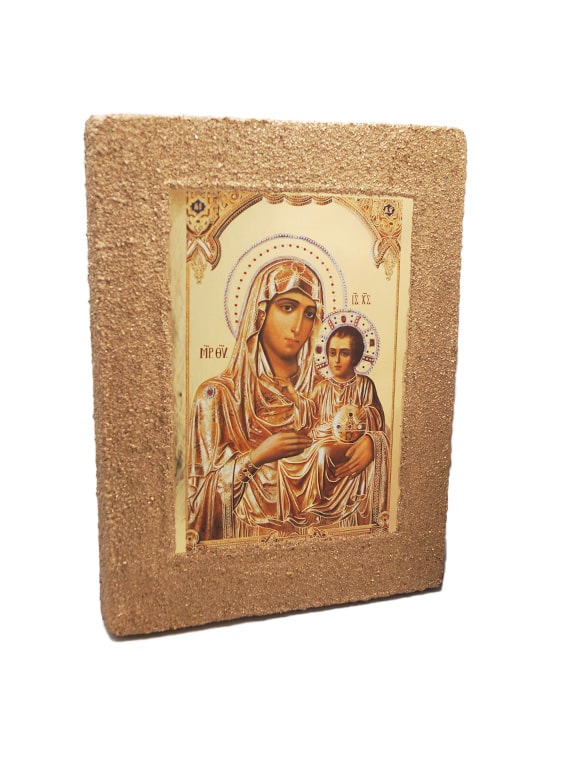
Panagia Ierousolymitissa – Gold-Print with Sandblasting – Mount Athos
$ 20.49
Description Gold-Print with Sandblasting Featuring Panagia Ierousolymitissa An extraordinary gold-print depicting *Panagia Ierousolymitissa* (Virgin Mary of Jerusalem). In 1870, at the Monastery of Mary Magdalene on Mount Sinai, there was a nun named Tatiana, a very talented iconographer considered one of the best not only in her monastery but also in the surrounding region. One day, as Tatiana fell asleep, she had a very unusual dream. A nun she did not know appeared in her cell and persistently asked her to paint her. Tatiana replied that she was an iconographer, not a portrait painter, and therefore only knew how to create icons in the classical Byzantine style. She explained that if the nun wanted a portrait, she should seek someone else. The nun insisted that Tatiana should paint her, and since she was not a portrait artist, she should make it an icon. Tatiana, hoping to get rid of the stranger, said she couldn’t because she didn’t have a suitable wooden panel. The nun replied that it was not a problem and immediately gave her a piece of iconography wood. Tatiana realized she could not dismiss the unknown nun so easily, so she took her tools and began to work. At that moment, the nun’s garments began to shine, and Tatiana immediately understood that she was not dealing with a human, but with the Virgin Mary herself! The Theotokos told Tatiana that she would be the second person after Luke to create her icon. Startled, Tatiana woke up and went immediately to the Abbess. When Tatiana returned with the Abbess to the cell, they noticed a fragrant aroma coming from behind the door. Upon opening it, they saw an icon of the Virgin Mary, exactly as Tatiana had seen her in the dream. The icon was therefore acheiropoietos (not made by human hands). The next day, Tatiana again saw the Virgin Mary in her dream, who asked her to take the icon to her home in Gethsemane. Today, Panagia Ierousolymitissa is a sacred pilgrimage site at the Mother of God’s tomb in Gethsemane and is considered highly miraculous, as it has responded to countless prayers of the faithful who visit. Embossed Gold-Print with Sandblasting: Features In the icon depicting the Annunciation of the Theotokos, the monastic iconographer used the technique of embossed gold-print to create a work of unique beauty. Gold-print is a type of thermo-printing technique. Thermo-printing is the method by which a very thin sheet of gold is applied to surfaces such as wood, leather, cardboard, or plastic using the pressure of a heated embossed plate (die). Around the edges of the icon, the sandblasting technique is also used—this is a process in which part or all of a surface is eroded by blasting it with sand under pressure. Dimensions: 19.5 x 15 x 1.5 cm Origin: Mount Athos
Related products
-
-70%